Download Doing Good Better: How Effective Altruism Can Help You Make a Difference, by William MacAskill
Just link your gadget computer system or device to the internet connecting. Get the modern technology making your downloading Doing Good Better: How Effective Altruism Can Help You Make A Difference, By William MacAskill finished. Also you do not wish to read, you can straight close guide soft data as well as open Doing Good Better: How Effective Altruism Can Help You Make A Difference, By William MacAskill it later on. You can likewise easily get the book everywhere, because Doing Good Better: How Effective Altruism Can Help You Make A Difference, By William MacAskill it remains in your device. Or when being in the workplace, this Doing Good Better: How Effective Altruism Can Help You Make A Difference, By William MacAskill is likewise recommended to review in your computer system tool.
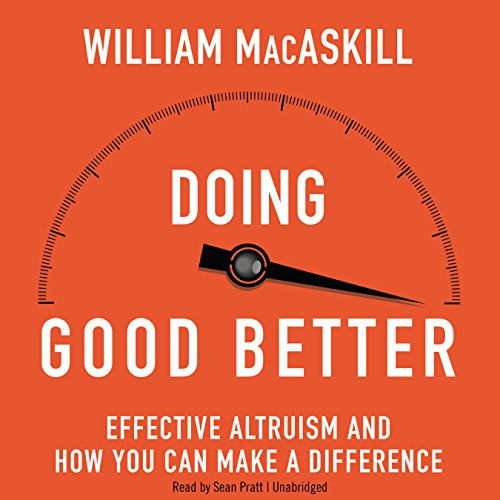
Doing Good Better: How Effective Altruism Can Help You Make a Difference, by William MacAskill

Download Doing Good Better: How Effective Altruism Can Help You Make a Difference, by William MacAskill
Doing Good Better: How Effective Altruism Can Help You Make A Difference, By William MacAskill Just how can you transform your mind to be a lot more open? There several sources that can help you to enhance your ideas. It can be from the various other experiences as well as story from some people. Book Doing Good Better: How Effective Altruism Can Help You Make A Difference, By William MacAskill is among the relied on resources to get. You can locate plenty books that we discuss right here in this site. And currently, we show you one of the best, the Doing Good Better: How Effective Altruism Can Help You Make A Difference, By William MacAskill
Undoubtedly, to improve your life quality, every publication Doing Good Better: How Effective Altruism Can Help You Make A Difference, By William MacAskill will certainly have their certain lesson. Nevertheless, having certain awareness will certainly make you feel a lot more confident. When you feel something occur to your life, often, reviewing e-book Doing Good Better: How Effective Altruism Can Help You Make A Difference, By William MacAskill could aid you to make calmness. Is that your real hobby? Often indeed, but sometimes will be unsure. Your selection to review Doing Good Better: How Effective Altruism Can Help You Make A Difference, By William MacAskill as one of your reading books, could be your correct e-book to check out now.
This is not around how much this e-book Doing Good Better: How Effective Altruism Can Help You Make A Difference, By William MacAskill prices; it is not additionally about exactly what sort of e-book you really like to check out. It is regarding exactly what you could take and also receive from reviewing this Doing Good Better: How Effective Altruism Can Help You Make A Difference, By William MacAskill You could favor to decide on various other book; but, no matter if you attempt to make this book Doing Good Better: How Effective Altruism Can Help You Make A Difference, By William MacAskill as your reading option. You will certainly not regret it. This soft documents e-book Doing Good Better: How Effective Altruism Can Help You Make A Difference, By William MacAskill could be your great friend regardless.
By downloading this soft documents e-book Doing Good Better: How Effective Altruism Can Help You Make A Difference, By William MacAskill in the on-line link download, you are in the 1st step right to do. This website actually offers you ease of the best ways to get the most effective book, from best seller to the new released e-book. You can locate more books in this website by seeing every web link that we give. One of the collections, Doing Good Better: How Effective Altruism Can Help You Make A Difference, By William MacAskill is one of the finest collections to sell. So, the very first you get it, the initial you will certainly get all favorable concerning this book Doing Good Better: How Effective Altruism Can Help You Make A Difference, By William MacAskill
[Read by Sean Pratt]
While a researcher at Oxford, trying to figure out which career would allow him to have the greatest impact, William MacAskill confronted the problem of how best to make meaningful change in the world. He discovered that much of the potential for change was being squandered by lack of information, bad data, and our own prejudice. As an antidote, he and his colleagues developed effective altruism, a practical, data-driven approach that allows each of us to make a tremendous difference regardless of our resources. MacAskill urges us to think differently, set aside biases, and use careful reasoning. When we do this, we find that each of us has the power to do an astonishing amount of good.
- Sales Rank: #2125912 in Books
- Published on: 2016-05-10
- Formats: Audiobook, CD
- Original language: English
- Number of items: 6
- Dimensions: 5.80" h x .70" w x 5.20" l,
- Running time: 25320 seconds
- Binding: Audio CD
- 1 pages
Review
Beautifully written and extremely smart. Doing Good Better should be required reading for anyone interested in making the world better. Steven D. Levitt, #1 New York Times bestselling co-author of Freakonomics and When to Rob a Bank
This is the most valuable guide to charitable giving ever published. Even readers who disagree with MacAskill's conclusions about the value of particular charitable donations will make smarter decisions by learning from his analysis. Paul Brest, co-director, Stanford Center on Philanthropy and Civil Society and former president, William and Flora Hewlett Foundation
A straightforward guide to help anyone make the largest possible difference in the lives of others. - Sue Desmond-Hellman, CEO of the Gates Foundation
We research hotels and headphones and sushi bars -- but not charities. That is lunacy. And in this powerful and persuasive book, William MacAskill shows us how much we stand to gain from a little bit of thoughtfulness: The same donation could do hundreds of times more good if given to the most effective charities, rather than the least. -Dan Heath, co-author of the New York Times bestsellers Made to Stick, Switch, and Decisive
Effective altruism -- efforts that actually help people rather than making you feel good or helping you show off -- is one of the great new ideas of the twenty-first century. Doing Good Better is the definitive guide to this exciting new movement. Steven Pinker, Johnstone Family Professor of Psychology at Harvard University and author of The Better Angels of Our Nature
Doing Good Better is a superb achievement. This must-read book will lead people to change their careers, their lives, and the world, for the better. Peter Singer, Ira W. DeCamp Professor of Bioethics at Princeton University, author of Animal Liberation and The Most Good You Can Do
Doing Good Better is a must-read for anyone with both a heart and a brain. MacAskill demolishes the lazy myths of nothing-you-can-do-ism and demonstrates the power of asking the right questions. This is an important book. It's also surprisingly fun. Figuring out what really helps people is a challenging scientific puzzle, and these pages are full of unexpected twists enlightening and invigorating. Joshua Greene, director of Harvard's Moral Cognition Lab, author of Moral Tribes
Humanity currently spends more money on cigarette ads than on making sure that we as a species survive this century. We've got our priorities all wrong, and we need effective altruism to right them. If you want to make a real difference on the biggest issues of our time, you need to read Doing Good Better. Jaan Tallinn, cofounder, Skype and Kazaa
Doing Good Better has rare combination of strikingly original ideas, effortless clarity of delivery, and a thoroughgoing practicality that leaves the reader inspired to get out of their chair and take on the world. Humanity faces some big challenges in the 21st century; this is a much-needed manifesto for social change, and Will MacAskill is the ideal ambassador. Eric Drexler, founder of nanotechnology and author of Engines of Creation
MacAskill tackles a monumental question: how can we make the biggest difference for the greatest number of people? His answer is a grand vision to make giving, volunteering, spending, and working more worthwhile. --Adam Grant, New York Times bestselling author of Give and Take
About the Author
William MacAskill is an associate professor in philosophy at Oxford University and the cofounder of the nonprofit organizations Giving What We Can and 80,000 Hours. These nonprofits have raised over $400 million in lifetime pledged donations to charity and helped to spark the effective altruism movement. He is a contributor to Quartz, the online business magazine of the Atlantic, and he and his organizations have been featured in the New York Times, the Wall Street Journal, NPR, and TED, among other media outlets.
Excerpt. © Reprinted by permission. All rights reserved.
INTRODUCTION
How can you do the most good?
Until 1989, Trevor Field was a typical middle-aged South African man who had lived a fairly normal life. He enjoyed fresh steaks, cold beer, and fishing with his friends. Working in advertising for magazines like TopCar and Penthouse, he had never thought seriously about using his skills for the greater good. When he discovered the PlayPump, however, everything changed.
That year, Field and his father-in-law, a farmer, visited an agricultural fair in Pretoria. There, he met a water engineer named Ronnie Stuiver who was demonstrating a model for a new type of water pump. The demonstration reminded Field of a fishing trip he’d taken years before, during which he had watched the women of a rural village wait for hours next to a windmill-powered water pump. There had been no wind that day, but the women, who had trekked for miles, still needed to bring water back to their homes. So they simply sat and waited for the water to flow. Field had been struck by how unfair this was. There simply must be a better way to do this, he thought. Now he was witnessing a potential solution.
Stuiver’s invention seemed brilliant. Instead of the typical hand pump or windmill pump found in many villages in poor countries, Stuiver’s pump doubled as a playground merry-go-round. Children would play on the merry-go-round, which, as it spun, would pump clean water from deep underground up to a storage tank. No longer would the women of the village need to walk miles to draw water using a hand pump or wait in line at a windmill-powered pump on a still day. The PlayPump, as it was called, utilized the power of playing children to provide a sustainable water supply for the community. “African [kids] have almost nothing—not even books in school let alone playground equipment—and access to water is a huge problem,” Field later told me. “I thought it was just the best idea I’ve ever seen.”
Field bought the patent from Stuiver and worked in his spare time over the next five years to improve the design. Using his experience in advertising, Field came up with the idea of placing billboard advertisements on the sides of the water tank as a way to generate revenue to pay for pump maintenance. In 1995, he secured his first sponsor, Colgate Palmolive; installed the first PlayPump; and quit his job in order to focus full-time on the project, now a registered charity called PlayPumps International. Progress was slow at first, but he persevered, paying for several pumps with his own money. At the same time, he developed connections with corporations and government bodies across South Africa to pay for more pumps. By the turn of the millennium, he had installed fifty pumps across the country.
His first major breakthrough came in 2000 when, out of three thousand applicants, he won a World Bank Development Marketplace Award, given to “innovative, early-stage development projects that are scalable and/or replicable, while also having high potential for development impact.” That award attracted funding and attention, which culminated in a site visit from Steve Case, CEO of AOL, and his wife, Jean. “They thought the PlayPump was incredible,” Field said. “As soon as they saw it in action, they were sold.” In 2005, the Cases agreed to fund the project and worked with Field to set up an American arm of PlayPumps International. Their aim was to roll out thousands of new PlayPumps across Africa.
The PlayPump became the center of a massive marketing campaign. Steve Case used his expertise from running AOL to pioneer new forms of online fund-raising. The One Foundation, a British fund-raising charity, launched a bottled water brand called One Water and donated the profits to PlayPumps International. It was a huge success and became the official bottled water of the Live 8 concerts and the Make Poverty History campaign. The PlayPump became the darling of the international media, who leaped at the opportunity to pun, with headlines like PUMPING WATER IS CHILD’S PLAY and THE MAGIC ROUNDABOUT. In an article for Time in 2006, Bill Clinton called the PlayPump a “wonderful innovation.”
Celebrities, too, jumped on the bandwagon. Jay-Z raised tens of thousands of dollars through his “The Diary of Jay-Z: Water for Life” concert tour. Soon after, PlayPumps International secured its biggest win: a $16.4 million grant awarded by then First Lady Laura Bush, launching a campaign designed to raise $60 million to fund four thousand PlayPumps across Africa by 2010. By 2007, the PlayPump was the hottest thing in international development, and Trevor Field was at the center of it all—a rock star of the charity world.
“It has just gone berserk! . . . When I first looked at this water pump . . . I could never imagine that this is something that could possibly change the world,” Field said in 2008, reflecting on PlayPump International’s startling success. “It really rocks me to know we’re making a difference to a lot of people who are nowhere near as privileged as I am or my family is.” By 2009, his charity had installed eighteen hundred PlayPumps across South Africa, Mozambique, Swaziland, and Zambia.
Then things went sour. Two damning reports were released, one by UNICEF and one by the Swiss Resource Centre and Consultancies for Development (SKAT). It turned out that, despite the hype and the awards and the millions of dollars spent, no one had really considered the practicalities of the PlayPump. Most playground merry-go-rounds spin freely once they’ve gained sufficient momentum—that’s what makes them fun. But in order to pump water, PlayPumps need constant force, and children playing on them would quickly get exhausted. According to the UNICEF report, children sometimes fell off and broke limbs, and some vomited from the spinning. In one village, local children were paid to “play” on the pump. Much of the time, women of the village ended up pushing the merry-go-round themselves—a task they found tiring, undignified, and demeaning.
What’s more, no one had asked the local communities if they wanted a PlayPump in the first place. When the investigators from SKAT asked the community what they thought about the new PlayPump, many said they preferred the hand pumps that were previously installed. With less effort, a Zimbabwe Bush hand pump of the same cylinder size as a PlayPump provided thirteen hundred liters of water per hour—five times the amount of the PlayPump. A woman in Mozambique said, “From five A.M., we are in the fields, working for six hours. Then we come to this pump and have to turn it. From this, your arms start to hurt. The old hand pump was much easier.” One reporter estimated that, in order to provide a typical village’s water needs, the merry-go-round would have to spin for twenty-seven hours per day.
Even when communities welcomed the pumps, they didn’t do so for long. The pumps often broke down within months, but unlike the Zimbabwe Bush Pump, the mechanics of the pump were encased in a metal shell and could not be repaired by the community. The locals were supposed to receive a phone number to call for maintenance, but most communities never received one, and those who did never got anyone on the phone. The billboards on the storage tanks lay bare: the rural communities were too poor for companies to be interested in paying for advertising. The PlayPump was inferior in almost every way to the unsexy but functional hand pumps it competed with. Yet, at $14,000 per unit, it cost four times as much.
Soon, the media turned on its golden child. PBS ran a documentary exposing the PlayPump’s many shortcomings. (One thing that didn’t change was the media’s love of puns: the documentary was called Southern Africa: Troubled Water; The Guardian repeatedly referred to the PlayPump as “money down the drain.”) In an admirable response to this criticism, the US arm of PlayPumps International shut down and its sponsor, the Case Foundation, publicly acknowledged that the program had been a failure. Yet, despite its fall from grace, the PlayPump lives on. Under the name of Roundabout Water Solutions, Field’s nonprofit continues to install the same model of PlayPumps across South Africa, funded by corporations like Ford Motor Company and Colgate Palmolive.
• • •
Most people want to make a difference in their lives and, if you’re reading this book, you’re probably no exception. As Trevor Field’s story illustrates, however, good intentions can all too easily lead to bad outcomes. The challenge for us is this: How can we ensure that, when we try to help others, we do so as effectively as possible? How can we ensure that we avoid accidentally causing harm, and succeed in having the greatest positive impact we can?
This book tries to help answer these questions. I believe that by combining the heart and the head—by applying data and reason to altruistic acts—we can turn our good intentions into astonishingly good outcomes. To illustrate, let’s look at a story with a very different ending from the one you just read about.
• • •
In 2007, at the peak of the PlayPump’s popularity, Michael Kremer and Rachel Glennerster launched an organization of their own, the culmination of decades of research into how to improve the lives of the poorest people in the world.
Glennerster had studied economics at the University of Oxford, graduating in 1988. She was interested in learning about poverty relief, so she decided to live in a developing country and spent a summer in Kenya. She spoke to people working in development, many of whom were deeply disillusioned. When she asked why, they told her to look at some of the ways development projects had backfired.
“I got sent down to big projects that had failed,” Glennerster told me. “I went to Lake Turkana, up in the north of Kenya. The Turkana people are basically nomadic, and various development projects had hoped to improve their quality of life by settling them on the lake, so they built a big factory for fish. They managed to get them to settle and fish in the lake, but then the lake got overfished, and the fish stock collapsed. . . . It was depressing.” Disenchanted about the potential to have an impact in global development, she moved into domestic policy, taking a job at the British Treasury.
Michael Kremer also spent some of his young adulthood in Kenya, living there for a year after finishing his undergraduate degree. Like Glennerster, he was concerned by extreme poverty and wanted to learn more, so he lived with a local family, teaching English at a secondary school. He also saw some dramatic ways in which attempts to improve conditions there were failing. When he returned to grad school, he decided to figure out how things could be done better.
Kremer and Glennerster met at Harvard University in 1990. Kremer was a PhD student; Glennerster was visiting on a Kennedy Scholarship, having taken a sabbatical from her work at the Treasury. By the time Kremer became a professor at MIT in 1993, he and Glennerster were married. As a vacation, they returned to Kenya to visit the family Kremer had lived with several years prior.
While there, Kremer spoke to Paul Lipeyah, a friend who worked for the Dutch charity International Christian Support (now called Investing in Children and Their Societies, or ICS). ICS’s main program was child sponsorship, in which a donor paid a regular amount to help an individual child or a small community. ICS had been trying to improve school attendance and test scores. They provided a package of different things: new textbooks and additional teachers to schools, and free school uniforms to the students. ICS had received new funding, and Paul Lipeyah was about to roll out the program to seven new schools.
Kremer urged Lipeyah to test his program using what’s called a randomized controlled trial: he would monitor and collect data for fourteen local schools, implementing the program in seven of them, while letting the other seven go about business as usual. By collecting data from all fourteen schools to see which fared better, he could find out if his program actually worked.
In hindsight, Kremer’s idea seems obvious. Randomized controlled trials are the gold-standard method of testing ideas in other sciences, and for decades pharmaceutical companies have used them to test new drugs. In fact, because it’s so important not to sell people ineffective or harmful drugs, it’s illegal to market a drug that hasn’t gone through extensive randomized controlled trials. But before Kremer suggested it, the idea had never been applied to the development world.
With the help of collaborators, Kremer tested the different ICS programs one by one. First, he looked at the efficacy of providing schools with additional textbooks. Classrooms would often have only one textbook for a class of thirty, so it seemed obvious that providing more textbooks would help students learn. However, when Kremer tested this theory by comparing test scores between schools that received books and those that didn’t, he found no effect for all but the most high-achieving of students. (He suggests the textbooks were written at too high a level for the children, especially considering they were in English, the pupils’ third language after Swahili and their local languages.)
Next, Kremer looked at providing flip charts. The schoolchildren couldn’t understand the textbooks, but having flip charts would allow teachers to tailor lessons to the specific needs of the students. Perhaps these would work better. Again, however, no effect.
Undaunted, he took a different approach. If providing additional materials didn’t work, maybe increasing the number of teachers would. After all, most schools had only one teacher, catering to a large class. But, again, he found no discernible improvement from decreasing class sizes.
Over and over again, Kremer found that seemingly obvious programs to improve education just weren’t working. But he persisted. He refused to believe there was simply no way to improve the education of children in Kenya. At that point, a friend at the World Bank suggested he test deworming.
Few people in developed countries know about intestinal worms: parasitic infections that affect more than one billion people worldwide. They aren’t as dramatic as AIDS or cancer or malaria, because they don’t kill nearly as many people as those other conditions. But they do make children sick, and can be cured for pennies: off-patent drugs, developed in the 1950s, can be distributed through schools and administered by teachers, and will cure children of intestinal worms for a year.
Kremer did an experiment to see whether treating children for these intestinal worms had an impact on education. The results were striking. “We didn’t expect deworming to be as effective as it was,” Kremer told me. “It turned out to be one of the most cost-effective ways of increasing school participation.”
Absenteeism is a chronic problem in schools in Kenya, and deworming reduced it by 25 percent. In fact, every child treated spent an extra two weeks in school, and every one hundred dollars spent on the program provided a total of ten years of additional school attendance among all students. Enabling a child to spend an extra day in school therefore cost just five cents. It wasn’t merely that deworming children “worked” at getting children into school. It worked incredibly well.
What’s more, deworming didn’t merely have educational benefits. It had health and economic benefits, too. Intestinal worms can cause a variety of maladies, including anemia, intestinal obstruction, and a suppressed immune system that can increase the risk of other diseases like malaria. Deworming decreases all these risks. Moreover, when Kremer’s colleagues followed up with the children ten years later, those who had been dewormed were working an extra 3.4 hours per week and earning an extra 20 percent of income compared to those who had not been dewormed. In fact, deworming was such a powerful program that it paid for itself through increased tax revenue.
By the time his work on deworming was published, Kremer’s revolutionary new approach to development had spawned a following, with dozens of the brightest young economists running hundreds of trials of different development programs. Meanwhile, Glennerster had quit her job and become the executive director of the newly founded Poverty Action Lab at MIT, where she used her knowledge of policy to ensure the research Kremer and his colleagues were conducting would have real-world impact.
In 2007, on the basis of this research, Kremer and Glennerster cofounded the nonprofit Deworm the World Initiative, which provides technical assistance to the governments of developing countries, enabling them to launch their own deworming programs. The charity has provided more than forty million deworming treatments, and the independent charity evaluator GiveWell regards them as one of the most cost-effective development charities.
• • •
When it comes to helping others, being unreflective often means being ineffective.
The PlayPump is the perfect example. Trevor Field and everyone who supported him were driven by emotions—the appeal of seeing happy children provide their communities with clean water through the simple act of playing—rather than facts. The Case Foundation, Laura Bush, and Bill Clinton supported the PlayPump not because there was good evidence to believe it would help people but because it had the thrill of a revolutionary technology. Even critics of the campaign would stop short of accusing Field and his supporters of bad intentions—they no doubt genuinely wanted to help the people of rural Africa. But relying on good intentions alone to inform your decisions is potentially disastrous.
It would be nice if the PlayPump were an isolated example of unreflective altruism, but sadly it’s just an extreme example of a much more general trend. We very often fail to think as carefully about helping others as we could, mistakenly believing that applying data and rationality to a charitable endeavor robs the act of virtue. And that means we pass up opportunities to make a tremendous difference.
Imagine, for example, that you’re walking down a commercial street in your hometown. An attractive and frighteningly enthusiastic young woman nearly assaults you in order to get you to stop and speak with her. She clasps a tablet and wears a T-shirt displaying the words Dazzling Cosmetics. You agree to let her speak, and she explains that she’s representing a beauty products company that is looking for investment. She tells you about how big the market for beauty products is, and how great the products they sell are, and how, because the company spends more than 90 percent of its money on making the products and less than 10 percent on staff, distribution, and marketing, the company is extremely efficient and therefore able to generate an impressive return on investment. Would you invest?
Of course you wouldn’t. If you wanted to invest in a company, you would consult experts or investigate different companies and compare Dazzling Cosmetics’ performance with the rest of them. Either way, you would look at the best available evidence in order to work out where you will get the most bang for your buck. In fact, almost no one is foolish enough to invest in a company that is pitched to them on the street—which is why the imaginary situation I described here never occurs. Yet, every year, hundreds of thousands of people donate to charities they haven’t heard of simply because a well-spoken fund-raiser whom they didn’t know asked them to. And they normally have no way of knowing what happened to the money they donated.
One difference between investing in a company and donating to a charity is that the charity world often lacks appropriate feedback mechanisms. Invest in a bad company, and you lose money; but give money to a bad charity, and you probably won’t hear about its failings. Buy a shirt that’s advertised as silk when it’s really polyester, and you’ll realize pretty quickly; but buy coffee that has a Fairtrade stamp on it, and you never know whether doing so helped people, harmed them, or did nothing. If it weren’t for the independent investigations by UNICEF and SKAT, PlayPumps International would have looked like a terrific success to those who supported it. Because we don’t get useful feedback when we try to help others, we can’t get a meaningful sense of whether we’re really making a difference.
Kremer and Glennerster succeeded in part because they didn’t assume they knew what the most effective way of helping people was. Instead, they tested their ideas before putting them into action. They were willing to revise their beliefs about what worked in light of the evidence they received and then went out and did what the evidence suggested they should do. In contrast with the PlayPump, the most effective program turned out to be remarkably boring: Grace Hollister, now the director of Deworm the World Initiative, told me that “deworming is probably the least sexy development program there is.” But by focusing on what was effective rather than what was emotionally appealing, they produced outstanding results, significantly improving the lives of millions of people.
Kremer and Glennerster exemplify a way of thinking I call effective altruism. Effective altruism is about asking, “How can I make the biggest difference I can?” and using evidence and careful reasoning to try to find an answer. It takes a scientific approach to doing good. Just as science consists of the honest and impartial attempt to work out what’s true, and a commitment to believe the truth whatever that turns out to be, effective altruism consists of the honest and impartial attempt to work out what’s best for the world, and a commitment to do what’s best, whatever that turns out to be.
As the phrase suggests, effective altruism has two parts, and I want to be clear on what each part means. As I use the term, altruism simply means improving the lives of others. Many people believe that altruism should denote sacrifice, but if you can do good while maintaining a comfortable life for yourself, that’s a bonus, and I’m very happy to call that altruism. The second part is effectiveness, by which I mean doing the most good with whatever resources you have. Importantly, effective altruism is not just about making a difference, or doing some amount of good. It’s about trying to make the most difference you can. Determining whether something is effective means recognizing that some ways of doing good are better than others. The point of this isn’t to lay blame, or to claim that some ways of doing good are “unworthy.” Rather, it’s simply to work out which ways of doing good are best, and to do those first. This project is crucial because, as we’ll discuss, the best ways of doing good are very good indeed.
I helped to develop the idea of effective altruism while a graduate student at the University of Oxford. I had begun donating to charity and wanted to ensure that my donations did as much to help others as possible. Along with Toby Ord, a postdoctoral researcher at Oxford, I began to investigate the cost-effectiveness of charities that fight poverty in the developing world. The results were remarkable. We discovered that the best charities are hundreds of times more effective at improving lives than merely “good” charities. In 2009, Toby and I cofounded Giving What We Can, an organization that encourages people to donate at least 10 percent of their income to these most cost-effective charities. Around the same time, two New York hedge fund analysts, Holden Karnofsky and Elie Hassenfeld, quit their jobs to start GiveWell, an organization that does extraordinarily in-depth research to work out which charities do the most good with every dollar they receive.
From there, a community developed. We realized that effective altruism could be applied to all areas of our lives—choosing a charity, certainly, but also choosing a career, volunteering, and choosing what we buy and don’t buy. On the basis of this, in 2011, I cofounded 80,000 Hours (a name that refers to the number of hours you typically work in your life), which provides advice and coaching on how to choose a career that will allow you to make the most difference.
In this book, I’ll present in more depth effective altruism’s approach to making a difference. What I hope to convey is not a series of facts but a new way of thinking about helping others, which you can take with you and apply in your own life. The first part of this book outlines effective altruism’s way of thinking, enabling us, in the second part of the book, to apply that way of thinking to specific issues.
In the first part, I dedicate each chapter to exploring one of effective altruism’s five key questions:
• How many people benefit, and by how much?
• Is this the most effective thing you can do?
• Is this area neglected?
• What would have happened otherwise?
• What are the chances of success, and how good would success be?
Asking these five key questions can help us avoid common pitfalls when thinking about doing good. The first question helps us to think concretely about how different actions improve people’s lives, so that we don’t squander our time or money on activities that don’t, ultimately, make people better off. The second question ensures we try to spend our efforts not on “merely good” activities but on the very best activities. The third question directs us to focus on those areas that receive comparatively little attention, and for which others haven’t taken the outstanding opportunities to make a difference. The fourth question helps us to avoid trying to do good works that would happen with or without our involvement. The fifth question helps us to think about uncertainty correctly, so that we can know when to pursue activities that have low odds of success but large potential payoffs instead of activities with guaranteed smaller benefits.
Taken together, these five questions help us to answer the guiding question of effective altruism: “How can I do the most good?” They form the core of effective altruism’s approach to making a difference.
In the second part of this book, I apply these questions to specific areas: How can I figure out which charities will do the most good with my donations? How can I choose a career or volunteering opportunity with the biggest impact? How much of a difference can I make through ethical consumption? Of the many problems in the world, how can I decide which to focus on? In each case, I provide a framework for thinking about the issue, a checklist of questions to help you ensure that you think through all the most important considerations. I hope to show how effective altruism can help us to have a greater impact in all aspects of our lives. For ease of reference, the frameworks and the five key questions are all restated in the appendix.
Before we begin, let me emphasize why these considerations are so important. In the next chapter, I’ll explain why each and every one of us has the power, if we so choose, to do extraordinary things.
ONE
Just how much can you achieve?
When the Occupy Wall Street movement gained traction in the fall of 2011, disaffected citizens of the Western world quickly adopted the term the 1 percent to refer to the top 1 percent of income earners in wealthy nations, primarily the United States. The term came from a popular statistic that the richest 1 percent of the population receives 24 percent of total income—that’s more than $340,000 per year, twelve times the $28,000 earned by the typical American worker. References to the 1 percent versus the 99 percent—i.e., the rest of the population—quickly became shorthand for the income gap in America.
Inequality in America is getting starker over time: while typical household income grew by less than 40 percent between 1979 and 2007, the income of the richest 1 percent grew by 275 percent in that same time period. The French economist Thomas Piketty, who gained international fame for his 2014 book Capital in the Twenty-First Century, has suggested that the level of income inequality in the United States is “probably higher than in any other society at any time in the past, anywhere in the world.”
This can lead those of us who aren’t in that 1 percent to feel powerless, but this focus neglects just how much power almost any member of an affluent country has. If people focus exclusively on American inequality, they’re missing an important part of the bigger picture. Consider this graph of global income distribution:
Source: Branko Milanovic, PovcalNet
This graph lines up everyone in the world, ordered by their income. The space between 0 and 25 percent represents the 25 percent of the world with the smallest incomes; the space between 75 and 100 percent represents the 25 percent of the world with the largest incomes. If everyone had the same income, the line would be flat, forming a neat rectangle under it. But they don’t. The poorest people in the world barely even register on the graph. Income soars when you hit the top 10 percent. And the richest 1 percent? That spike goes off the chart. If I wanted to draw the whole of this graph so that you could see where the spike ends, this book would have to be as tall as a twenty-three-story building, taller than the original Godzilla.
Where do you fall on this graph? You obviously won’t know for sure, since I’ve deliberately left the vertical axis unlabeled, but have a guess. What percentage of the world’s population is above you in income, and what percentage is below?
When I ask residents of the United States or the United Kingdom this question, they typically guess they fall into the seventieth or eightieth percentile. They know they’re from an affluent country, but they also know they’re not like those bankers and CEOs who make up the global elite. They therefore guess that they’re at the corner of the curve, peering up at the megarich who sit atop that spike. That’s what I used to think, too.
Here’s that graph with the vertical axis labeled.
Source: Branko Milanovic, PovcalNet
If you earn more than $52,000 per year, then, speaking globally, you are the 1 percent. If you earn at least $28,000—that’s the typical income for working individuals in the United States—you’re in the richest 5 percent of the world’s population. Even someone living below the US poverty line, earning just $11,000 per year, is still richer than 85 percent of people in the world. Because we’re used to judging ourselves in comparison with our peers, it’s easy to underestimate just how well off those of us in rich countries are.
You might be feeling skeptical at this point. I certainly was when I first heard these facts. “Sure,” you might say, “the poor in developing countries might not have much money, but that money can pay for so much more because the cost of living in those places is cheaper.”
It’s true that money goes further overseas. When I was in Ethiopia, I ate at one of Addis Ababa’s fanciest restaurants, and the bill came to about ten dollars. I even once stayed in a hotel room (albeit, a nasty one) for a night for one dollar. However, that graph of income inequality has already taken into account the fact that money goes further overseas. Let’s look at that bottom 20 percent of the world’s population: that’s 1.22 billion people who earn less than $1.50 per day, and thereby count as members of the “extreme poor.” You might assume that “$1.50 per day” means that every day the extreme poor live on the equivalent of $1.50 in their local currency. But it actually means they live on an amount of money equivalent to what $1.50 could buy in the United States in 2014. What can $1.50 buy you in the United States? A candy bar? A bag of rice?
You might still be skeptical. Perhaps, you think, people in poor countries can live on less than $1.50 a day because they produce a lot of their own goods. They don’t have much money but they don’t need that much money because they farm their own land and mainly live off what they grow. Again, however, this has already been taken into account in that graph. Suppose Annette is a farmer who earns $1.20 per day from selling her produce, but who also eats forty cents’ worth of what she grows per day. According to the way these figures are calculated, she lives on $1.60 per day and is therefore above the $1.50-per-day poverty line.
You might wonder: How can anyone live on such little money? Surely they’d die? And the answer is . . . they do. At least, they die much more regularly than those of us who live in developed countries do. Even though average life expectancy in developing countries has skyrocketed over the last few decades, in poor countries in sub-Saharan Africa it is only fifty-six years, compared to over seventy-eight years in the United States. In other dimensions, their lives are just as lacking as you’d expect given their earnings. In order to get a full picture of what life is like for the extreme poor, Professors Abhijit Banerjee and Esther Duflo, economists at MIT, conducted a survey of more than thirteen countries. They found that the extreme poor consume an average of fourteen hundred calories per day—about half of what is recommended for a physically active man or a very physically active woman—while spending most of their income on food. The majority are underweight and anemic. Most households own radios but lack electricity, toilets, or tap water. Less than 10 percent of households possess a chair or a table.
There is, however, one way in which the $1.50-per-day figure can’t quite be cashed out as “what $1.50 could buy in the United States in 2014.” In the United States, because there is no extreme poverty, there is no market for extremely cheap goods. The lowest-quality rice you can buy in the United States is far better than what you could buy in Ethiopia or India. The room I rented in Ethiopia for one dollar a night was far worse than anything I could rent in the United States. (Trust me on this.) The very worst housing you can buy in the United States is far better than the mud-brick houses typical for those living below the $1.50-per-day extreme-poverty line. This explains how someone living in extreme poverty can still have a “home,” but it doesn’t do much, if anything, to improve life in extreme poverty.
• • •
The fact that we’ve found ourselves at the top of the heap, globally speaking, provides us with a tremendous opportunity to make a difference. Because we are comparatively so rich, the amount by which we can benefit others is vastly greater than the amount by which we can benefit ourselves. We can therefore do a huge amount of good at relatively little cost.
Just how much good should we expect to be able to do? Let’s very simplistically suppose that by some social action—giving to a development charity, buying fair-trade items, or something else—we make ourselves a dollar poorer and thereby make an Indian farmer living in extreme poverty a dollar richer. How much greater a benefit would that dollar provide the poor Indian farmer than it would provide for ourselves? It’s a basic rule of economics that money is less valuable to you the more you have of it. We should therefore expect a dollar to provide a larger benefit for an extremely poor Indian farmer than it would for you or me. But how much larger?
Economists have sought to answer this question through a variety of methods. We’ll look at some of these in the next chapter, but for now I’ll discuss just one method, which is to ask people directly about their well-being. (Estimates via other methods would support my conclusion at least as well as this one does.)
In order to work out the relationship between level of income and level of subjective well-being, economists have conducted large-scale surveys of income levels and the subjective well-being of people in each of them. Their results are given in this graph, which shows the relationship between income and subjective well-being both within a country and across countries.
Source: Betsey Stevenson and Justin Wolfers
The vertical axis of this graph represents self-reported well-being. Those interviewed had to say how satisfied they were with their lives on a scale from 0 to 10. Rating yourself at 10 means you consider yourself maximally happy: you think that, realistically, life couldn’t get any better. Rating yourself at 0 means you consider yourself maximally unhappy: you think that, realistically, life couldn’t get any worse. Most people fall in the middle of this range. The horizontal axis represents annual income.
What’s interesting about this graph is that a doubling of income will always increase reported subjective well-being by the same amount. For someone earning $1,000 per year, a $1,000 pay rise generates the same increase in happiness as a $2,000 pay rise for someone earning $2,000 per year, or an $80,000 pay rise for someone already earning $80,000 per year. And so on.
This graph allows us to determine just how much greater a benefit the extreme poor receive from one dollar than you or I do. Imagine if your boss called you into her office and told you your salary would double for the next year. You’d be pretty pleased, right? What the conclusions from the economic studies suggest is that the benefit you get from having your salary doubled is the same as the benefit an extremely poor Indian farmer gets from having his salary doubled. If you’re on the typical US wage of $28,000 per year, the benefit you’d get from an additional $28,000 in income is the same as the benefit a poor Indian farmer would get from an additional $220.
This gives us a good theoretical reason for thinking that the same amount of money can do one hundred times as much to benefit the very poorest people in the world as it can to benefit typical citizens of the United States. If you earn as much as the typical American worker, then you are one hundred times as rich as the very poorest people in the world, which means additional income can do a hundred times as much to benefit the extreme poor as it can to benefit you or me. This isn’t to say that income is all that matters to well-being—of course other factors like safety and political freedom are involved. But income certainly plays a critical role in how enjoyable, long, and healthy your life is. Looking at how much we can benefit people via increasing their income gives us a particularly robust way of assessing how much we can benefit others compared to ourselves.
It’s not often you have two options, one of which is one hundred times better than the other. Imagine a happy hour where you could either buy yourself a beer for five dollars or buy someone else a beer for five cents. If that were the case, we’d probably be pretty generous—next round’s on me! But that’s effectively the situation we’re in all the time. It’s like a 99-percent-off sale, or getting 10,000 percent extra free. It might be the most amazing deal you’ll see in your life.
This idea is important enough that I’ve given it a name. I call it the 100x Multiplier. For those of us living in rich countries, you should expect to be able to do at least one hundred times as much to benefit other people as you can to benefit yourself.
The 100x Multiplier should surprise us. We shouldn’t expect to be able to do so much to benefit others at such little cost to ourselves. But we live in an unusual place during an unusual time.
It’s an unusual place because, if you’re reading this book, then, like me, you’re probably lucky enough to be earning $16,000 per year or more, putting you in the richest 10 percent of the world’s population. That’s a remarkable situation to be in.
It’s an unusual time because it comes after a period of remarkable economic progress, which has led to some of the world experiencing what is, historically, fabulous wealth. In 1800, the gross domestic product per person per year in America was only $1,400 (in today’s money), whereas now it’s more than $42,000. In a mere two hundred years, we’ve become thirty times richer. But it is a time following remarkably unequal economic progress. Despite the riches of people like us, there are still billions living in abject poverty. This is highly unintuitive, as can be seen by this graph of gross domestic product per person, over the last two thousand years.
Source: Angus Maddison
For almost all of human history—from the evolution of Homo sapiens two hundred thousand years ago until the Industrial Revolution 250 years ago—the average income across all countries was the equivalent of two dollars per day or less. Even now, more than half of the world still lives on four dollars per day or less. Yet, through some outstanding stroke of luck, we have found ourselves as the inheritors of the most astonishing period of economic growth the world has ever seen, while a significant proportion of people stay as poor as they have ever been.
Moreover, because of that economic progress, we live at a time in which we have the technology to easily gather information about people thousands of miles away, the ability to significantly influence their lives, and the scientific knowledge to work out what the most effective ways of helping are. For these reasons, few people who have ever existed have had so much power to help others as we have today.
Sometimes we look at the size of the problems in the world and think, “Anything I do would be just a drop in the bucket. So why bother?” But, in light of the research shown in these graphs, that reasoning doesn’t make any sense. It’s the size of the drop that matters, not the size of the bucket, and, if we choose, we can create an enormous drop. We’ve already seen that we have the opportunity to provide a benefit for others that is one hundred times greater than the benefit we could provide for ourselves. That we can’t solve all the problems in the world doesn’t alter in any way the fact that, if we choose, we can transform the lives of thousands of people.
TWO
Question #1: How many people benefit, and by how much?
June 21, 1994. Kigali, Rwanda. Two months into one of the most horrific genocides the world has ever witnessed, James Orbinski manned a small Red Cross hospital, a tiny wellspring amid a moral wasteland.
Most helpful customer reviews
58 of 60 people found the following review helpful.
Thoughtful and well written book about effective altruism.
By Russell Fanelli
It will probably come as no surprise to many readers of this review that The Charities Aid Foundation lists the United States as the most charitable nation in the world. We are now and have been a generous people both with our time and treasure.
My guess is that many people reading this review are charitable people who want to know if their hard earned money is well spent when they give it to their favorite charity. In his new book, William MacAskill, cofounder of the Effective Altruism Movement, gives us a thoughtful method for determining what charities will make best use of our contributions and make a genuine difference for good in the lives of desperate and destitute people.
In Part One of his book he answers these questions:
1. How many people benefit, and by how much?
2. Is this the most effective thing you can do?
3. Is this area neglected?
4. What would have happened otherwise?
5. What are the chances of success, and how good would success be?
In order to accurately answer these questions, economists have developed a metric called the quality-adjusted life year (QALY). Time and again MacAskill will use this metric to highlight effective and ineffective organizations. Toward the end of his book he gives us a list of those charities that pass the QALY muster such as GiveDirectly, Deworm the World International, Against Malaria Foundation, etc.
Part Two of MacAskill's book shows us Effective Altruism in Action. From beginning to end he tells us interesting stories about people who make a difference for good. He makes the point repeatedly that even small contributions that are well placed can significantly impact the quality of life of poor and sick people. He often challenges our assumptions about strongly held beliefs such as that we should avoid purchasing products made in sweatshops. We are not wrong about the dreadful conditions in many of these workplaces, but the true fact is that work in a sweatshop is much to be preferred over even worse alternatives.
As we think about our own pattern of giving to charity, MacAskill encourages us to establish a regular habit of giving and to evaluate carefully whether our time spent serving in a charitable organization or working to earn money to give the organization is more valuable. We need to plan carefully what we will do to incorporate altruism into our everyday lives. MacAskill suggests that we join the effective altruism community (effectivealtruism.org), put our name on their mailing list, and invite our neighbors to do the same.
From beginning to end Doing Good Better is about enlightened behavior; that is, thinking less about self and more about connecting with networks that make a difference for good in the lives of the poor and unfortunate people of this world. People who read MacAskill's well written and thoughtful book have a game plan for action, not only in how to contribute meaningfully to worthy charities, but also to consider how to structure their lives to get the most from their talents and the best opportunities to use these talents to help others.
I mentioned at the beginning of this review that Americans are a giving people. William MacAskill gives us a plan and a program to channel our best tendencies and motivations in directions that will do the greatest good for the greatest number of people. Highly recommended.
8 of 8 people found the following review helpful.
Fun: 8/10, useful: 10/10
By Smind
Now this book is the kind of thing that can change your thinking radically - yet its conclusions are so evident that you wonder why nobody thinks about the topic this way.
Doing Good Better is well-written and well-researched. For people familiar with the subject matter there will be some repetition. However, I was positively surprised that compared to Peter Singer's 'The Most Good You Can Do', MacAskill's book is really full of new information and new ways of thinking about things.
MacAskill breaks effective altruism down into five key questions and a few core topics. Each of them is illustrated with examples that are actually good to know. That's a key difference to 'The Most Good You Can Do'.
For example, the chapter on ethical consumerism tells you which popular climate-saving measures are not really helping much (and which are) and the chapter on expected value helps you figure out which risks are worth taking, e.g. how bad it is to ride a motor bike compared to using ecstasy. The careers chapter contains some options I might actually try.
All of this culminates into a pretty decent understanding of how to make a big difference.The book ultimately provides ways to get involved with the effective altruism movement.
A read that's both entertaining and indispensable if you want to make a difference.
4 of 4 people found the following review helpful.
Doing Good *Much* Better
By William Kiely
Doing Good Better is a great introduction to effective altruism and the sort of rational, evidence-based reasoning that is extremely helpful to making sure that what we do in our lives actually effectively fulfills our values.
Without explicitly asking ourselves MacAskill's Second Key Question of Effective Altruism, "Is this the most effective thing you can do?" we may end up having a "merely very good" impact with our lives, which surprisingly is nowhere near as good as the best impact we potentially could have.
As MacAskill writes, "When it comes to doing good, fat-tailed distributions seem to be everywhere. It’s not always true that exactly 80 percent of the value comes from the top 20 percent of activities—sometimes things are even more extreme than that, and sometimes less. But the general rule that most of the value generated comes from the very best activities is very common" (p. 50).
If we don't consciously try to achieve the most good we can and purse that challenge with careful reasoning, then it's likely we won't achieve anywhere near our potential. That's why effective altruism is important and why I was very happy to learn that there is a growing community of people who agree about the importance of this sort of thinking.
See all 111 customer reviews...
Doing Good Better: How Effective Altruism Can Help You Make a Difference, by William MacAskill PDF
Doing Good Better: How Effective Altruism Can Help You Make a Difference, by William MacAskill EPub
Doing Good Better: How Effective Altruism Can Help You Make a Difference, by William MacAskill Doc
Doing Good Better: How Effective Altruism Can Help You Make a Difference, by William MacAskill iBooks
Doing Good Better: How Effective Altruism Can Help You Make a Difference, by William MacAskill rtf
Doing Good Better: How Effective Altruism Can Help You Make a Difference, by William MacAskill Mobipocket
Doing Good Better: How Effective Altruism Can Help You Make a Difference, by William MacAskill Kindle
Doing Good Better: How Effective Altruism Can Help You Make a Difference, by William MacAskill PDF
Doing Good Better: How Effective Altruism Can Help You Make a Difference, by William MacAskill PDF
Doing Good Better: How Effective Altruism Can Help You Make a Difference, by William MacAskill PDF
Doing Good Better: How Effective Altruism Can Help You Make a Difference, by William MacAskill PDF